
Is Tirzepatide a Peptide and What the Research Really Says
You want to feel better, but you are scared of hurting your heart
You are exhausted all the time.
Your weight will not move no matter what you do.
Your motivation is gone and you do not feel like yourself.
Someone mentions testosterone therapy and your first thought is fear.
“I’ve heard it’s bad for your heart.”
“I don’t want to trade energy for a heart problem.”
“I just want to feel normal again, not worse.”
These are real concerns. We hear them on calls every day.
Why TRT and Heart Health Feel So Confusing
If you search online, you find two loud opinions.
One says testosterone is dangerous.
The other says it fixes everything.
That leaves you stuck in the middle, unsure who to trust.
The truth is more nuanced than either extreme.
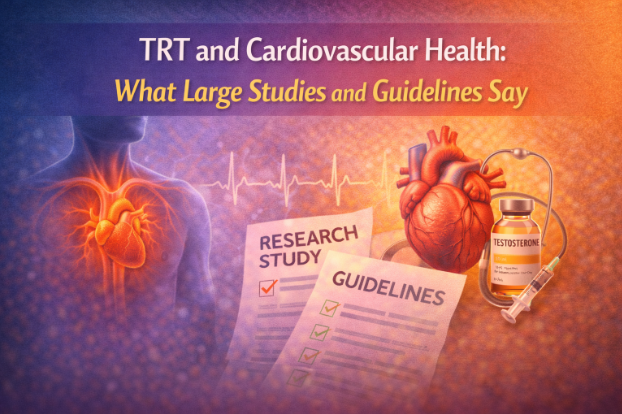
What Large Studies Actually Show About TRT and Cardiovascular Health
Older studies raised concerns about heart risk.
Many of them were small, poorly designed, or looked at very sick populations.
More recent and larger studies tell a different story.
They show that properly prescribed testosterone, monitored closely, does not increase heart risk for most people.
Some studies even show improved markers like:
- Better insulin sensitivity
- Reduced fat mass
- Improved cholesterol balance
This matters because low testosterone itself is linked to higher heart risk.
Why Low Testosterone Can Increase Cardiovascular Risk
This part often gets skipped.
When testosterone is low, your body tends to:
- Store more belly fat
- Lose muscle
- Develop insulin resistance
- Stay inflamed
Patients describe it like this.
“My body feels inflamed all the time.”
“I’m gaining weight no matter what.”
“I feel sluggish and heavy.”
These issues raise cardiovascular risk over time.
Ignoring low testosterone does not protect your heart.
Is Tirzepatide a Peptide and Why It Comes Up in This Conversation
Yes. Tirzepatide is a peptide.
Peptides are small messengers that tell your body how to act.
Semaglutide and tirzepatide help with appetite and blood sugar control.
Many people ask about these because weight loss feels impossible.
Patients tell us:
“I don’t want to be on shots forever.”
“I’m scared of gaining the weight back.”
“I want to fix what’s actually broken.”
Peptides can help manage symptoms.
They do not address hormone imbalance or why weight gain started.
Conventional Medicine vs Functional Medicine Approaches
Conventional medicine often looks at risk in isolation
You may be told testosterone is risky without looking at your full picture.
Visits are short.
Labs are basic.
Symptoms are brushed aside.
Functional medicine looks at the whole system
We ask why your hormones dropped.
We assess inflammation, insulin resistance, and cardiovascular markers together.
We use advanced testing to understand how your body is functioning now, not just if you fit into a range.
The goal is not to push TRT.
The goal is to decide if it is appropriate, safe, and truly helpful for you.
Supporting Heart Health Alongside Hormones
Functional care focuses on protection and support.
This includes:
- Monitoring blood markers closely
- Supporting sleep and stress
- Improving nutrition and movement
Some patients also benefit from foundational tools like hydrolyzed bovine collagen peptides to support joints, recovery, and overall metabolic health so the body can heal and respond better.
Nothing is done blindly.
Why Feeling Better Should Not Feel Risky
If you are scared to feel better, something has gone wrong in the conversation.
You deserve care that explains risks clearly, not through fear.
You deserve to understand your options without pressure.
And you deserve to know why your body feels stuck.
Want to Learn More Before Making Any Decisions?
If you are trying to lose weight, feel better, and protect your heart, education is the first step.
Our podcasts and webinars explain hormones, weight loss resistance, and how functional medicine evaluates risk without rushing into treatment.
No pressure.
No scare tactics.
Just clear information so you can make confident choices about your health.
When you understand the full picture, the path forward feels a lot less intimidating.